When Life Gets Blurry: The Art and Philosophy of Adjusting Your Focus
In photography, a blurred image is often the result of an incorrect focus. The subject is lost in a haze, details are softened, and the intended moment becomes indistinct. Yet, the solution is remarkably simple: adjust the lens, recalibrate the point of attention, and bring clarity back to the scene. This principle, born in the technical world of cameras, holds a profound metaphorical truth for our lives. When our personal or professional vision becomes fuzzy—when stress clouds our judgment, when overwhelm dilutes our passion, when routine obscures our purpose—the remedy is the same. We must consciously adjust our focus.
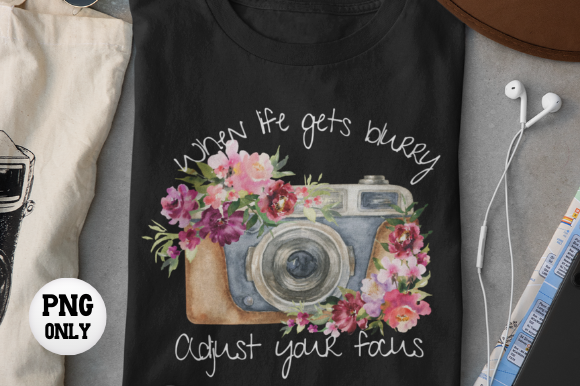
This idea is beautifully captured in artistic expressions like the "When Life Gets Blurry Adjust Your Focus" shirt design. More than just apparel, it serves as a wearable reminder of a vital life skill. Combining this poignant mantra with elements of creative passion—such as a hand-drawn, watercolor floral camera—it speaks to both the photographer and the philosopher within us. It merges the technical with the aesthetic, the practical with the inspirational.
Focus in Photography: The Technical Foundation
To understand the metaphor, we must first grasp the literal. Focus in photography is the process of making a specific subject or part of the image sharp and clear. It involves manipulating the camera's lens to ensure that light converges correctly on the sensor or film. A photographer chooses a focal point: perhaps a person's eyes, a delicate flower petal, or the leading edge of a building. Everything else, depending on settings, may fall into softer focus, creating depth and narrative.
Manual focus requires intentionality and practice. Autofocus offers assistance, but the artist still decides where attention should lie. This act of selection is fundamental. It determines what the story of the image will be. A vintage retro camera design, like those featured on many photographer-themed gifts, embodies this history of deliberate craftsmanship. Each shot required thoughtful composition and precise adjustment.
The Significance of Choosing Your Point of Focus
Why does this matter? Because in a world filled with visual noise, focus creates meaning. It directs the viewer's experience. In life, we are constantly bombarded by information, obligations, and stimuli. Without a chosen focal point, our mental and emotional "image" becomes a chaotic, blurry mess. We lose sight of our priorities, our joys, and our goals. The purpose of the "adjust your focus" philosophy is to reclaim that agency. It is the practice of identifying what is truly important in a given moment, a day, or a phase of life, and directing your energy there.
Applying the Principle: From Lens to Life
How do we translate this technical action into daily living? It begins with awareness. Recognize when things feel "blurry." This might be a sense of general anxiety, lack of motivation, creative block, or feeling disconnected from your work or relationships.
The next step is to "adjust." This adjustment can be practical and tangible:
- Simplify Your View: Just as a photographer might use a prime lens with a fixed focal length, limit your inputs. Reduce the number of tabs open on your browser, curate your social media feeds, or declutter your physical space.
- Change Your Angle: A different perspective can bring clarity. If a problem seems insurmountable, physically move. Take a walk, talk to someone with a different viewpoint, or literally look at the situation from a new spot.
- Prioritize Depth of Field: In photography, depth of field controls how much of the scene is in sharp focus. In life, decide how many projects or commitments you can handle with clarity at once. It's often better to have one or two things in sharp detail than ten in a hazy semi-attention.
- Manual Override: Don't rely solely on automatic routines. Consciously manually "focus" on a single task. Practice deep work for an hour on one project, or dedicate an evening solely to family without multitasking.
The Creative Intersection: Wearable Inspiration
Art and design play a crucial role in reinforcing such principles. A "Boho Camera Quotes" shirt or a "Watercolor Floral Photography Camera" design acts as a creative anchor. It embodies the fusion of technical art (photography) with free-flowing aesthetics (bohemian style, hand-drawn florals). For the photography lover, the professional photographer, or a member of a photography club, such items are more than gifts. They are tokens of identity and reminders of their craft's deeper lessons.
These designs, often available as digital PNG files for personal use, offer immense versatility. Their practical relevance extends far beyond a t-shirt. As a digital product with a transparent background and high-resolution 300 DPI quality, the same design can be printed on mugs, framed as art, or used in scrapbooking. This adaptability mirrors the core idea: a single, clear, beautiful concept (the focus mantra and the camera art) can be applied to multiple facets of life (wearables, home décor, creative projects).
Common Misunderstandings About Focus
A key assumption to clarify is that "adjusting your focus" means ignoring everything else. In photography, a shallow focus highlights a subject while the background contributes to the mood. In life, adjusting focus doesn't mean neglecting all other responsibilities. It means giving primary, sharp attention to your chosen priority, while other elements exist in a managed, supportive state. It's about hierarchy of attention, not exclusion.
Another misunderstanding is that focus is static. Once set, it's done. Both in camera work and in life, focus is dynamic. As the subject moves, as light changes, as your goals evolve, you must refocus. The "When Life Gets Blurry" mantra accepts blurriness as a natural, recurring state. The emphasis is on the adjustment, the ongoing process of recalibration.
Modern Relevance: Focus in a Distracted World
In our current era of technology, constant connectivity, and information overload, the ability to focus is not just a creative skill; it is a critical survival skill. It fits into modern work as the antidote to burnout. In business, it's the strategy behind core objectives. In education, it's the practice of deep learning versus superficial browsing. For creativity, it's the path to original output amidst a sea of influences.
The vintage camera in modern design serves as a poignant symbol here. It represents a slower, more intentional technology. Integrating its image with a contemporary message creates a bridge between timeless wisdom and present-day challenges. It suggests that the solutions to our modern blurriness might lie in re-embracing principles of deliberate attention.
Building a Broader Understanding
Ultimately, the concept of adjusting focus is a holistic life skill. It connects:
- The Technical: The learned, practical steps to achieve clarity in a task.
- The Artistic: The aesthetic and creative choice of what deserves the spotlight.
- The Philosophical: The mindfulness and intentionality behind directing one's consciousness.
- The Personal: The application in relationships, self-care, and personal growth.
Whether you are a professional photographer seeking a gift for your club, a creative individual looking for inspirational apparel, or someone simply navigating a complex life, the message is universal. Life will, inevitably, get blurry. Stress, change, and overwhelm will soften the edges of your clarity. The power lies not in preventing the blur, but in possessing the tool—and the reminder—to adjust. To turn the lens, to choose a new focal point, and to bring back the sharp, beautiful details that define your unique picture.
And sometimes, that reminder can be as simple and enduring as a piece of art you wear or display—a watercolor floral camera intertwined with a few wise words, prompting you daily to reframe, refocus, and move forward with clear intent.