Finding Your Summer Style: A Practical Guide to Watercolor Citrus Orange Clipart
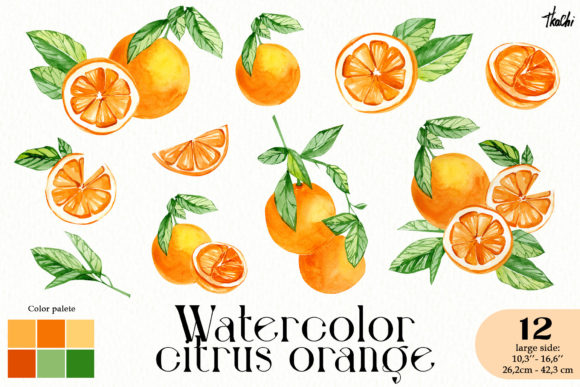
For designers, content creators, and small business owners seeking a vibrant aesthetic, clipart collections offer a foundational resource. Among the many styles available, watercolor designs have carved out a distinct niche, combining artistic texture with digital versatility. The specific collection named Watercolor Citrus Orange Clipart. Summer represents a focused example within this broader category. It is a digital product comprising twelve high-resolution illustrations centered on the theme of bright, juicy citrus fruits, primarily oranges, with floral accents, all rendered in a watercolor technique.
What makes this collection distinct is its deliberate thematic cohesion and technical specifications. The images are not just generic fruit illustrations; they are styled to evoke a specific seasonal feel—summer—through the use of warm, saturated colors and the soft, organic blends characteristic of watercolor paint. Each file is provided at a high quality of 300 DPI with considerable dimensions (approximately 6700 pixels on the larger side), making them suitable for both print applications like posters and clothing, and digital uses for web and social media where scalability is key.
Evaluating Watercolor Clipart Against Other Digital Art Styles
When considering resources for a project, understanding the broader landscape of digital art formats is crucial. Watercolor clipart, like the Citrus Orange Summer collection, sits alongside several other common styles: vector graphics, photographic stock, and digital illustrations in flat or line-art styles.
Vector graphics, typically created in software like Adobe Illustrator, are defined by mathematical paths. Their primary strength is infinite scalability without quality loss; a vector icon can be resized from a button to a billboard seamlessly. However, they often lack the textured, organic feel of traditional media. Watercolor clipart, while provided as high-resolution raster images (like JPEGs or PNGs), offers that very texture—the bleed of color, the grain of paper, the variation in brush strokes. This makes it a compelling choice when the design goal is to convey warmth, authenticity, or a hand-crafted aesthetic. The tradeoff is that raster images have fixed dimensions; scaling them significantly beyond their provided size can lead to a loss of sharpness. Therefore, the large base size of this collection is a practical advantage, extending its usable range.
Compared to photographic stock images of fruit, watercolor clipart offers a different kind of flexibility. Photographs are bound by realism and lighting conditions. A watercolor illustration is inherently artistic and stylized, allowing it to integrate more easily into varied layouts without competing with photographic elements. It can be layered, blended, and used as a decorative element rather than a central subject. For a brand wanting to suggest freshness and vitality without using a literal, commoditized stock photo, this stylistic approach can be more distinctive.
Identifying the Best Fit for Your Project
The decision to use a resource like Watercolor Citrus Orange Clipart. Summer hinges on aligning its attributes with your project's specific needs. Its strengths are clear: a unified summer theme, high-quality files ready for both print and digital use, and the appealing watercolor texture that can elevate simple designs.
Consider these practical use cases where this collection might be the right choice:
- Branding for a Seasonal Campaign: A cafe launching a summer citrus drink menu could use these illustrations across social media posts, in-store posters, and digital flyers to create a cohesive and cheerful visual identity.
- Designing for Print-on-Demand Products: The high-resolution 300 DPI files are expressly suited for printing. An entrepreneur creating a line of summer-themed T-shirts, tote bags, or postcards would find the large image size critical for maintaining print quality.
- Creating Web and Social Media Graphics: The bright and juicy color palette is inherently engaging and can increase visual appeal in blog headers, Instagram story overlays, or email newsletter banners.
However, there are scenarios where you might need to explore alternatives. If your project requires absolute scalability—for instance, a logo that must work on a mobile app icon and a massive trade show banner—a vector format would be a more flexible foundation, even if you later incorporate watercolor textures as effects. Similarly, if your theme extends beyond citrus and summer into a broader range of fruits or year-round imagery, a more diverse clipart pack or a subscription to a stock service with wider variety might be a better fit. This collection is specialized, which is its strength when the theme matches, but a limitation when a broader scope is needed.
Key Decision Factors: Beyond the Aesthetic
When evaluating a digital art collection, visual appeal is just the starting point. Several practical factors warrant consideration.
First, examine the technical specifications in relation to your output mediums. The stated size of "larger side 22.3 inch / 6700 px at 300 DPI" is robust for most print applications. For large format printing like posters, verifying that the specific image dimensions meet your printer's requirements is a prudent step. For purely digital use, the pixel dimensions ensure you can crop and adapt the images without immediately encountering quality issues.
Second, consider the licensing and usage terms. The notice "© TkachiDesignStudio, Anna Tkachenko" indicates a specific creator and requires respect for their copyright. Typically, such clipart is sold for commercial use, but it's essential to confirm the exact license included with the purchase. Does it allow use on physical products for sale? Is there a limit on the number of impressions? Clarifying these points before purchase prevents future complications.
Finally, assess the cohesion of the set. A collection with twelve images offers a workable library for a focused campaign, but not an endless resource. Evaluate whether the variations within the pack—likely different compositions of oranges, slices, and perhaps leaves or flowers—provide enough distinct elements for your planned projects without requiring you to supplement heavily with other assets.
Making an Informed Choice for Your Creative Toolkit
Resources like Watercolor Citrus Orange Clipart. Summer serve as tools, not solutions. Their value is unlocked by matching their capabilities to a well-defined problem. For a designer needing to quickly establish a warm, summery, and artisanal visual theme across multiple touchpoints, this collection reduces the time spent sourcing or creating individual assets. The watercolor style adds a layer of perceived quality and effort that flat graphics might not convey.
The alternative path, of course, is to commission custom illustrations or to develop a personal skill set in creating watercolor digital art. This offers total creative control and unique results, but at a significantly higher cost in time or money. For many independent creators and small businesses, a pre-made collection of high quality represents a balanced middle ground—acquiring a professional aesthetic without the overhead of custom work.
In essence, if your needs align with a bright, citrus-inspired, summer-focused design language, and your projects involve both digital and print outputs that benefit from textured artwork, this watercolor clipart collection presents a strong, practical option. If your requirements demand infinite scalability, a much wider thematic range, or a completely unique artistic signature, then your search would logically extend to vector resources, broader stock libraries, or the realm of custom illustration. By weighing these factors against your specific goals, you can move beyond simple comparison to a confident decision about the right resource for your creative endeavor.